





| ARTIST | Caravaggio |
|---|---|
| TITLE | Basket of Fruit |
| YEAR | between circa 1597 and circa 1600 |
A Quiet Miracle Emerging on the Table. The Perfect Realism That Became a Turning Point in Western Art History
In Western art history, this is a monumental work that first broke away from being a supporting role in religious paintings and portraits, and opened the door to "still life painting" as an independent genre.
This work is said to have been produced by Cardinal del Monte, an important patron of Caravaggio, to be given to Cardinal Federico Borromeo, who was the Archbishop of Milan. Borromeo highly praised the unparalleled beauty of this work, and left written records stating that although he searched his whole life for a still life painting that could rival this, he could never find one.
Recent X-ray investigations have revealed that this work is a reuse of an old canvas, and was originally painted over a grotesque pattern drawn by his friend Prospero Orsi.
While seemingly a simple painting at first glance, the intense revolutionary spirit of Caravaggio, which overturns the existing hierarchy of painting, breathes within it.
Luxurious Silence Orchestrated by Optical Illusions and Fine Depictions That Draw the Viewer In
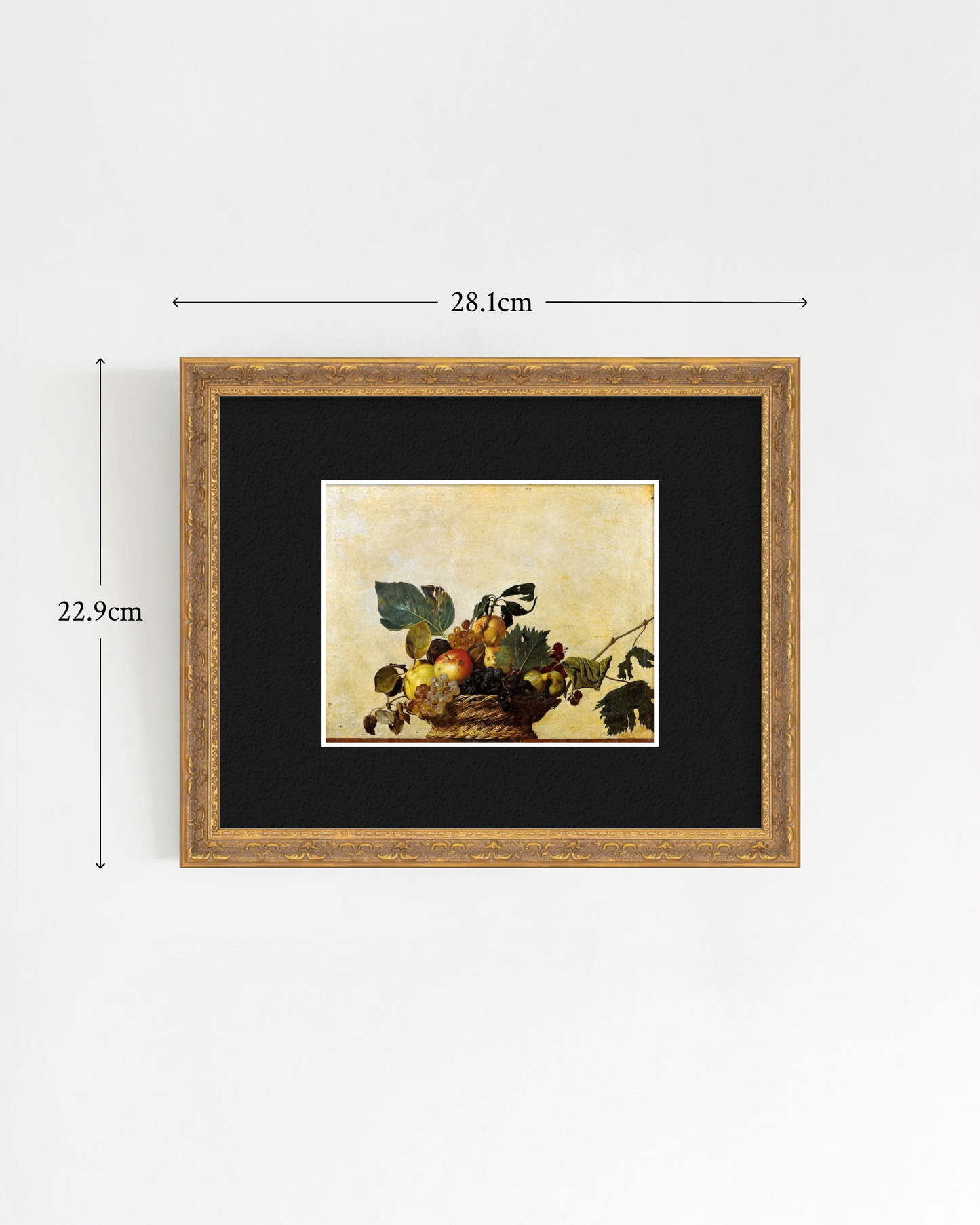
The fruit piled in the basket is depicted with such a raw texture that you feel you could touch it, strongly shaking the viewer's senses. The worm-eaten holes made by moth larvae on the peach leaves, the apples full of spots showing traces of insect invasion, and the grape leaves that have dried up and shrunk brown. These fine expressions of the process of "decline and decay" accompanying the passage of time are not merely copies of beauty. They are sometimes perceived as Christian teachings or metaphors, such as those in the Old Testament, preaching the transience of earthly wealth and youth. What is most attractive about decorating this work indoors is its thoroughly calculated spatial composition. The fruit basket is placed on the edge of the table that pierces the very bottom of the screen, protruding slightly towards the viewer's space. This skillful optical illusion (trompe l'œil) produces a sense of presence as if the fruit basket is crossing the frame of the painting and jumping out into reality. This noble and refined appearance brings a deep meditative aesthetic to a dining space or private study.


