





| ARTIST | Gustav Klimt |
|---|---|
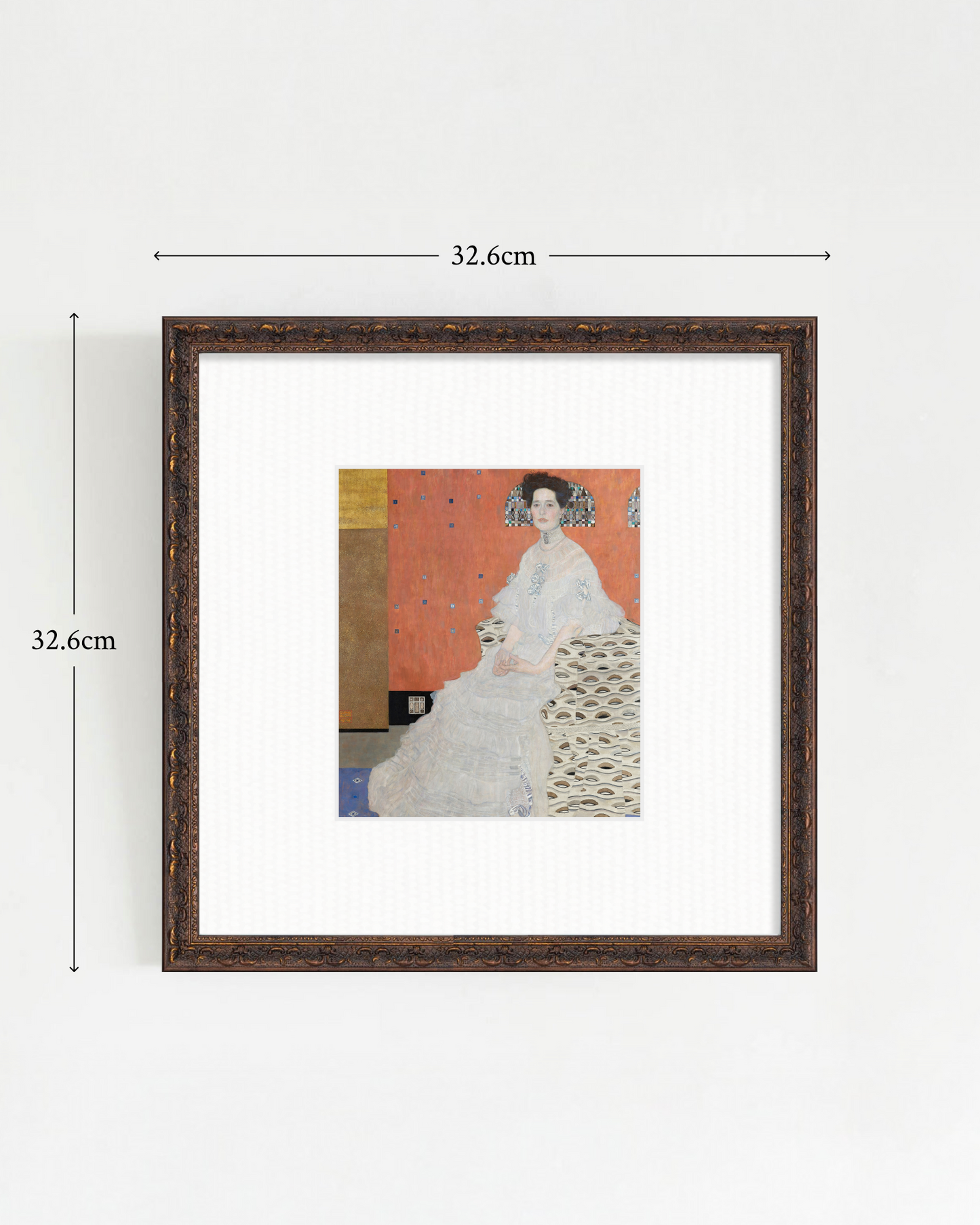
| TITLE | Portrait of Fritza Riedler |
| YEAR | 1906 |
Luxurious Margins and Golden Geometry. Bringing the Sparkle of Fin-de-Siècle Vienna to a Modern Living Room
"Portrait of Fritza Riedler," produced in 1906 by Gustav Klimt, who brought a revolution to the art world of fin-de-siècle Vienna. The model, Fritza, was a highly educated woman born in Berlin who frequently traveled between Berlin and Vienna. Her husband, Alois Riedler, was a renowned mechanical engineer who served as a professor at the Technical University of Berlin-Charlottenburg.
Klimt produced this work in his studio on Josefstädter Straße in Vienna.
In order to express uncompromising perfect harmony and beauty, it is said that the painter took an unusually long time to complete this refined portrait.
This portrait brilliantly depicts the intellect and elegance of the wealthy bourgeois class, whose economic and cultural influence was rapidly increasing at the time. After the deaths of Alois and Fritza, it was sold to the Austrian Gallery by her sister's hands, and currently continues to fascinate people around the world as a representative collection of the Belvedere Palace Museum in Vienna.
The Aesthetics of a Refined Composition Fascinating with Overwhelming Realistic Depiction and Mosaic Decoration
This work is positioned in the transition period to the "Golden Phase" that Klimt would later establish, and figuration and abstraction coexist in a brilliant balance. The soft, fluffy white lace and heavy satin dress she wears are depicted with breathtaking detail and rich three-dimensionality. In contrast, the chair she sits on and the background wall are replaced with flat decorations using gold leaf, silver leaf, and mosaic-like geometric patterns. This vivid contrast between "thorough realistic depiction" and "flat abstract decoration" is exactly the innovative expression method pioneered by Klimt. The semi-circular mosaic arranged behind her head evokes the portraits of young girls painted by the court painter Velázquez, who was very popular in Vienna at the time. At the same time, it functions like a secular holy light that elevates her to a special existence. A color design where pale apricot, refined white, and blue-gray reminiscent of silence harmonize beautifully. It is a piece that brings quiet elegance and rich expansiveness to the space of a contemporary interior.


