


An Artwork Where a Sense of Space Unfolds Within Silence
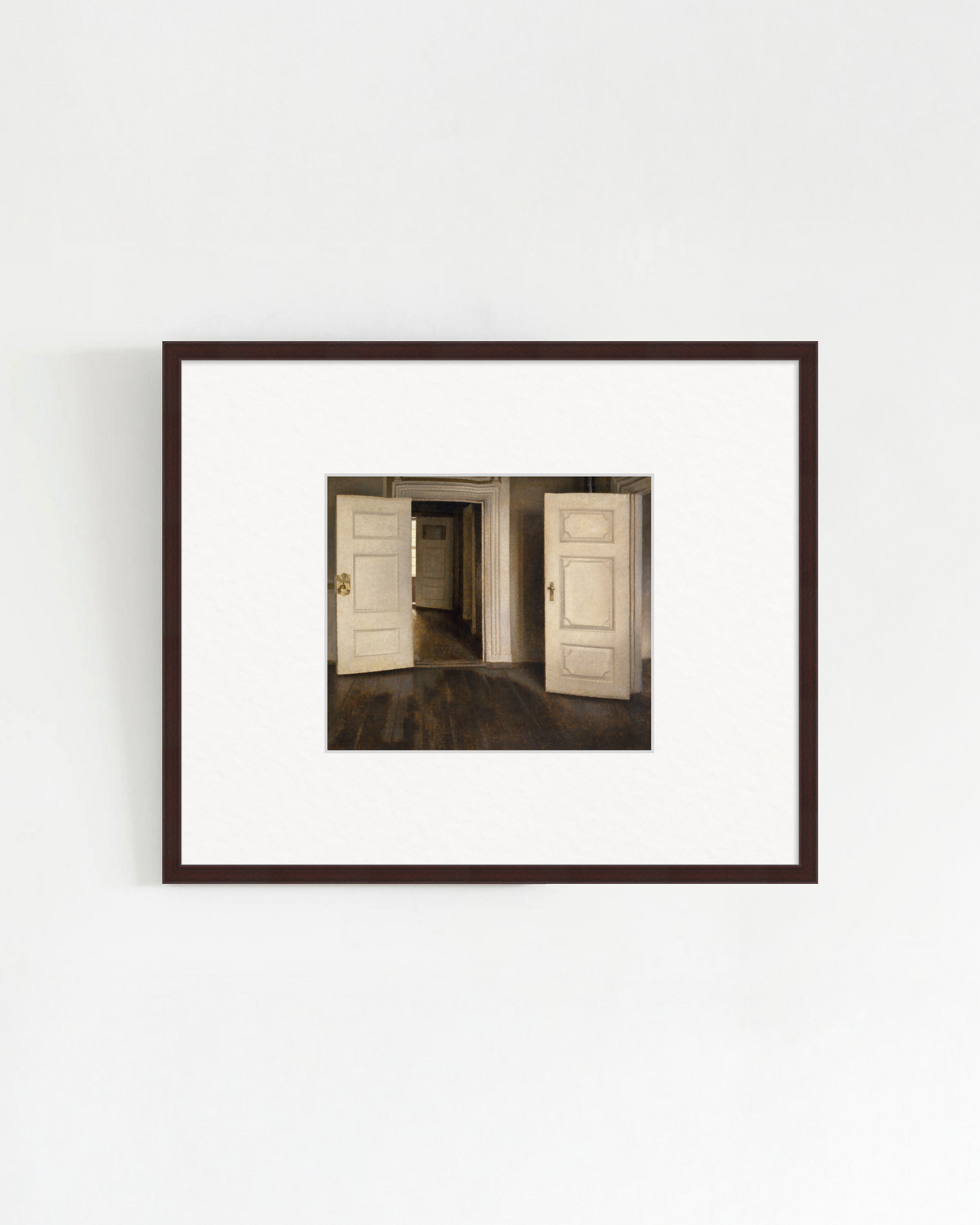
“Open Doors” (1905), where three open doors draw the gaze straight into the distance, is a quintessential serene interior painting by Vilhelm Hammershøi. The interior, devoid of human figures and composed solely of pale light and a gradation of grays, holds a peculiar tension that captivates despite nothing happening. The composition, with doors opening in succession, creates a sense of space extending somewhere beyond, even though it is a closed room.
In the early 1900s, Hammershøi continuously depicted interiors in Copenhagen and spaces within his home with restrained colors and clear compositions. This work is a representative example, where the stripped-down walls, the diffusion of light, and the repetition of doors create a quiet rhythm. Viewers are left to imagine what lies beyond the doors, savoring the silence within the painting itself.
Sophisticated Depth Created by Gray Gradations and Straight Lines
The charm of this work lies in its almost monochromatic color scheme and its neatly structured composition. By creating space without using strong colors, the entire canvas exudes tranquility, and the subtle differences in light and shadow on the walls and floor, conversely, enhance the sense of depth. While minimal, it avoids being cold, conveying a quiet intensity that harmonizes well with modern spaces and interiors that value negative space.
